Home / Blog / Role guides
Role guides
Legal e-billing analyst jobs: in-house vs law-firm work
E-billing titles hide two different operating positions. In-house teams receive and control outside-counsel invoices; law-firm teams configure and transmit bills against each client's rules. Follow the invoice to see which job you are reading.
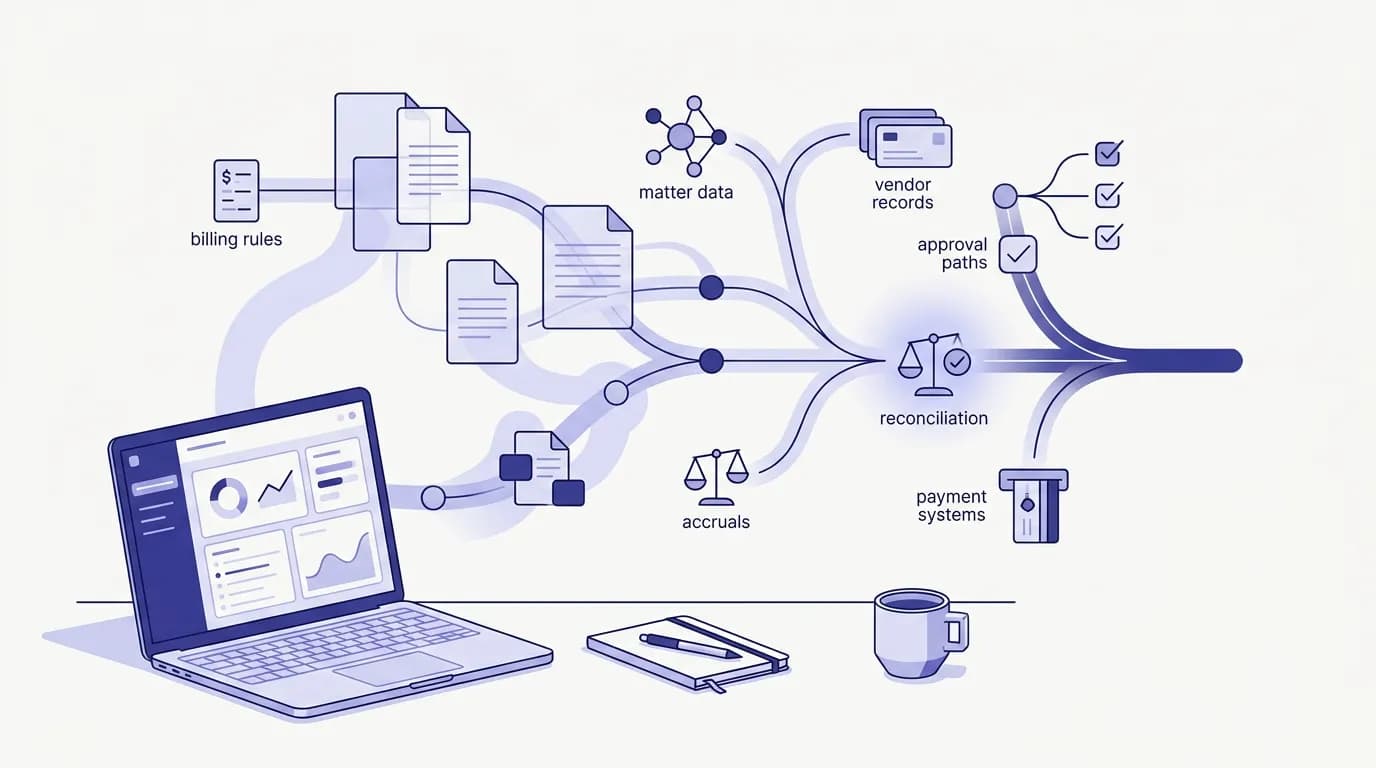
The fastest test: which direction does the invoice move?
An in-house e-billing role receives invoices from law firms and moves them through matter records, billing rules, review, approval, accounts payable, and reporting. A law-firm role prepares and transmits bills into each client's platform, then resolves validation errors, reductions, rejections, and payment follow-up. Both may mention matters, rates, budgets, accruals, vendors, and e-billing systems. The direction of the invoice tells you whose controls the analyst operates and whose questions arrive in the exception queue.
In-house work joins Legal, Finance, AP, and outside counsel
A current Coherent Legal Operations Specialist – Billing description places day-to-day e-billing administration inside a global legal department and connects invoice, accrual, vendor, and billing-data accuracy across Legal, Finance, Accounts Payable, outside counsel, and other providers. Read that pattern as a chain of controls: the vendor and matter must exist, the invoice must match the engagement and billing rules, the right reviewer must act, and the approved record must reconcile with payment and reporting. Broader roles may add budget tracking or spend analysis, but accurate processing is the base layer. The legal spend analyst guide shows where reliable records become forecasts, variance explanations, and decision support.
Law-firm work starts with each client's rules
On the law-firm side, the analyst converts outside counsel guidelines and engagement terms into working billing configurations. Cravath's 2026 E-Billing & Compliance Analyst description covered client and matter setup, timekeeper rates, LEDES mapping, task and activity codes, invoice transmission, rejected or adjusted bills, accruals, budgets, user support, and training. The recurring challenge is not simply uploading a file. It is keeping the firm's billing record, the client's rules, and the external platform aligned closely enough for the bill to pass and for any exception to be explained and corrected.
Use the exception queue to judge the analytical depth
A role becomes more revealing when something fails. Ask whether the analyst only reroutes the item or identifies why the exception happened. A rejected invoice might come from a rate mismatch, an unapproved timekeeper, an invalid task code, a closed matter, a missing approver, a billing-guideline breach, or inconsistent records between systems. Strong descriptions name investigation, audit trail, root-cause work, training, configuration changes, or recurring workflow improvement. They also show who owns the final policy, commercial, accounting, or legal decision. Attention to detail matters, but the deeper skill is separating data, policy, workflow, and integration problems before escalating them.
Do not confuse e-billing operations with provider strategy
CLOC's Financial Management competency places accurate e-billing beside budgets, accruals, forecasting, predictability, and Finance collaboration. Its Firm & Vendor Management competency separately covers RFPs, pricing models, due diligence, onboarding, business reviews, and relationship alignment. A posting that operates invoice controls and provider records is not automatically an outside-counsel strategy role. Repeated ownership of firm selection, engagement terms, rate strategy, performance reviews, panel status, or future work allocation signals the wider mandate described in the outside counsel manager guide.
Build application evidence around one invoice and one exception
Choose a real example and describe the handoffs without exposing confidential matter or client information. State which record arrived, which rule or control applied, what failed, how you traced the cause, who had decision authority, what you corrected or recommended, and how the final status was recorded. Relevant evidence can come from legal billing, accounts payable, finance operations, vendor onboarding, matter administration, law-firm revenue teams, or systems support. Use the legal operations analyst requirements guide to translate adjacent experience, then compare current legal operations jobs and create a job alert for e-billing, legal billing, spend, accruals, LEDES, and matter-management terms.