Home / Blog / Career comparisons
Career comparisons
Legal project manager vs legal operations manager: which role fits?
Legal project managers usually organize the delivery of matters or defined initiatives. Legal operations managers usually improve the department that delivers the work. The overlap is real, but the operating clock and expected outputs reveal the difference.
Start with the operating clock
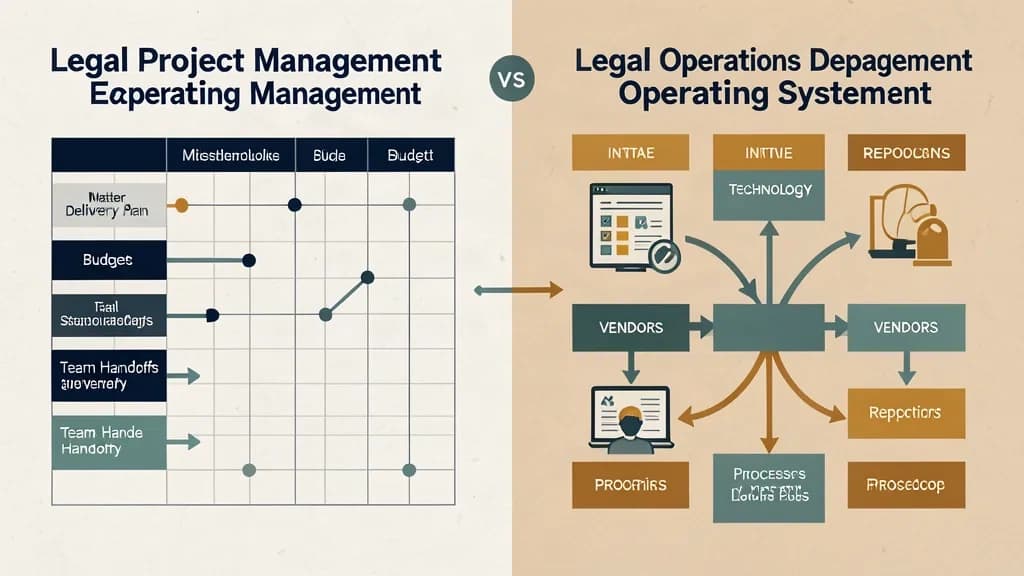
A legal project manager usually works to a matter or project clock: scope the work, build the plan, assign responsibilities, track milestones, manage the budget, surface risks, coordinate updates, and close the work with lessons captured. A legal operations manager usually works to a department clock: improve intake, systems, spend controls, vendor processes, reporting, knowledge, and service delivery across many matters and teams. CLOC includes Project/Program Management within a wider legal-operations framework, so project management can be one legal-ops capability without being the whole function. Ask whether the role's main promise is to deliver defined work well or to improve the operating environment in which legal work is delivered.
The deliverable test is more reliable than the title
For a project-management role, concrete outputs often include a scope, project plan, workstream tracker, staffing plan, budget, status report, risk log, client update, and post-matter review. A 2026 law-firm Legal Project Manager description retrieved through Justia joins those outputs to fee estimates, alternative fee arrangements, profitability, time-entry quality, client expectations, and matter closure. Covington's project-management analyst description similarly connects matter strategy and goals with budget templates, status reporting, course correction, training, and post-matter assessment. Legal operations outputs are usually more reusable across the function: an intake model, system roadmap, vendor process, dashboard definition, billing control, data standard, training program, or governance routine.
Law-firm LPM roles often sit close to matter economics
In a law firm, legal project management commonly supports partners and matter teams serving external clients. That makes scope, staffing, fee arrangements, budgets, time recording, profitability, deadlines, and client communication central signals. Dykema's 2026 posting describes planning, execution, and closing support for matters, process mapping, reporting, improvements, tool evaluation, and documented know-how. The role can influence how legal work is delivered without deciding the legal position. If a posting repeatedly names partners, practice groups, client teams, pricing, fee estimates, matter plans, or portfolio profitability, treat it as matter-delivery work even when it sits beside innovation or operations.
In-house legal operations usually owns a wider service system
An in-house legal operations manager may run projects, but the portfolio usually persists after an individual project ends. It can include legal intake and triage, matter management, e-billing, outside counsel, vendors, budgets, technology, reporting, knowledge, training, and change adoption. CLOC separates Project/Program Management from Financial Management, Firm & Vendor Management, Business Intelligence, Technology, Knowledge Management, and other operating areas. That breadth changes the success question. A project manager asks whether defined work reached the agreed scope, time, budget, and communication standard. An operations manager also asks whether the department now has a repeatable process, reliable data, clear ownership, sustained adoption, and a way to improve the service over time.
Hybrid roles can be decoded with two columns
Divide the posting into temporary outputs and durable operating assets. Temporary outputs belong to a named matter, implementation, migration, or initiative: a plan, launch, budget, milestone, status report, or close-out. Durable assets remain in use across future work: a taxonomy, workflow, platform configuration, reporting definition, vendor routine, training program, or governance rule. Then mark the authority verbs. Coordinate, track, facilitate, forecast, and escalate often indicate delivery control. Own, select, standardize, govern, administer, and optimize often indicate operating-system control. A hybrid role may legitimately contain both columns; the balance shows which experience should lead your application.
Build your application example around one controlled handoff
Choose a piece of work where several people, deadlines, decisions, and data points had to stay aligned. For a project-management application, explain the scope, plan, dependencies, budget or resource constraint, status rhythm, risk response, and close-out. For legal operations, explain the recurring service problem, process or system change, ownership model, data or control introduced, adoption work, and review signal. Do not claim authority you did not hold; state what you owned, what you coordinated, and what you escalated. Compare the broader legal operations manager job-description guide, the legal operations career path, and current legal operations jobs before deciding which evidence to foreground.