Home / Blog / Role guides
Role guides
Legal spend analyst jobs: from clean data to decision support
A legal spend analyst does more than report what was paid. The useful work is making matter, invoice, budget, accrual, and provider data reliable enough to explain what changed and support the next decision.
The role has five layers, and job descriptions choose different cut-off points
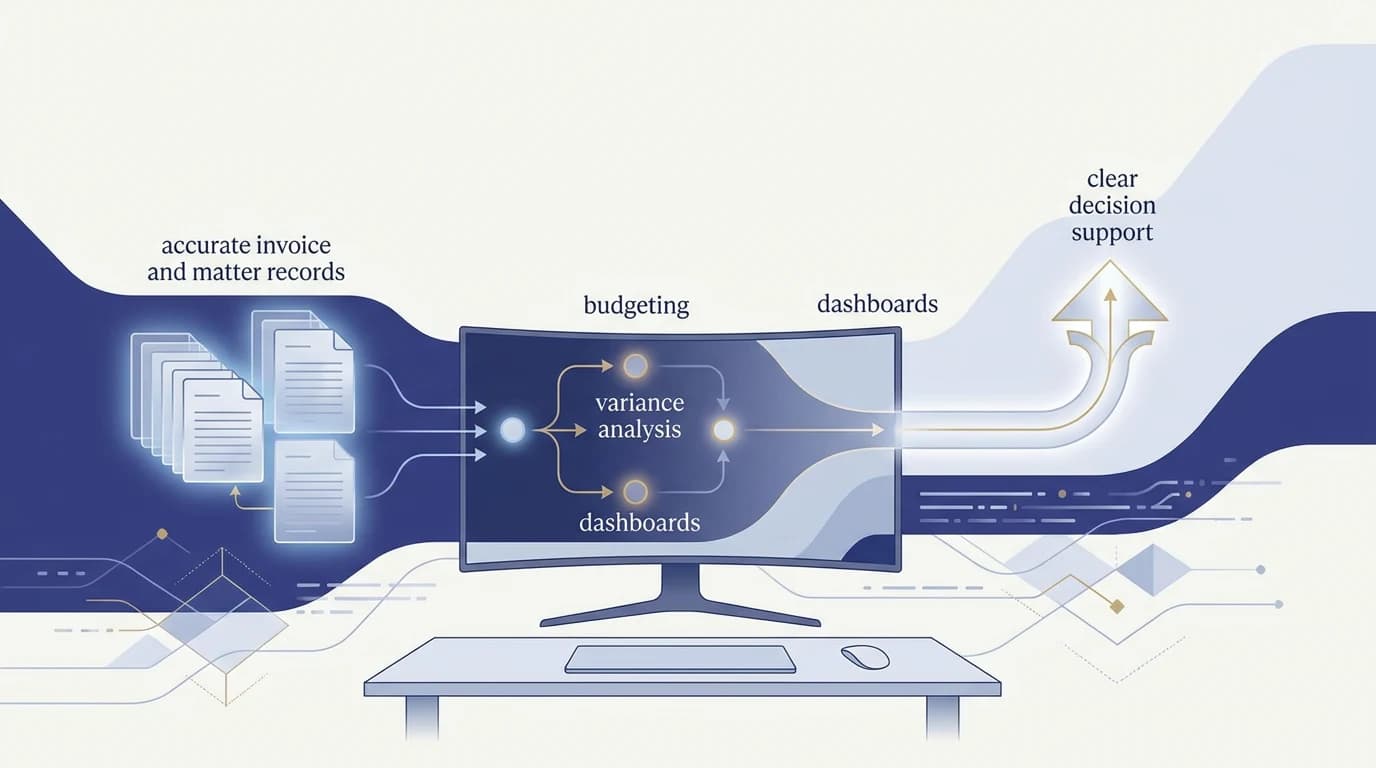
Legal spend work can be read as a five-layer stack: transaction controls, data quality, financial planning, analysis, and decision support. Transaction controls cover invoice rules, approvals, and adjustments. Data quality keeps matter, vendor, rate, timekeeper, fee-arrangement, and accounting fields consistent. Financial planning adds budgets, accruals, forecasts, and variance tracking. Analysis explains patterns by matter, provider, practice area, business unit, or cost driver. Decision support turns that explanation into options for legal leadership. Some jobs stop at the first two layers; others expect the analyst to work across all five. That cut-off point matters more than whether the title says analyst, senior analyst, or specialist.
Reliable analysis starts before the dashboard
A chart cannot repair an undefined matter category, duplicate provider, outdated rate, missing accrual, or invoice posted in the wrong period. Before interpreting a trend, an analyst needs to know which system supplied each field, which date controls the reporting period, how rejected or adjusted invoices appear, whether budgets and forecasts use the same scope, and who owns corrections. CLOC treats financial management and business intelligence as separate legal-operations competencies for a reason: one creates a dependable financial process, while the other organizes and visualizes data for decisions. Current State Street and UKG descriptions connect both, combining spend tracking and reporting with budgeting, forecasting, accruals, vendor records, controls, and e-billing or matter-management data.
Use three questions to test whether a report is analytical
First ask what changed: actual spend versus budget, forecast, prior period, matter plan, or another stated baseline. Then ask why: timing, scope, staffing mix, rates, volume, coding, fee structure, vendor choice, or a data-quality issue may each produce a similar variance. Finally ask what decision the finding can support: correct a record, update a forecast, investigate a matter, review a rate, change an approval rule, or prepare a provider discussion. A useful analyst separates observation from explanation and explanation from recommendation. The data may show that spend rose; it does not prove the cause without matter context and a traceable comparison.
Read the verbs to find the role's decision boundary
Build a simple authority map from the posting. Maintain, reconcile, validate, and produce usually signal responsibility for the data and recurring process. Analyze, model, explain, and present indicate interpretation. Recommend, challenge, negotiate, approve, and allocate suggest progressively wider commercial or program authority, but an interview should confirm who makes the final decision. State Street's 2026 description extends into executive insights, financial models, rate negotiations, and strategic vendor decisions; UKG's analyst role emphasizes surfacing observations and building judgment within scope. Neither pattern is universally senior or junior. Ask who approves forecasts, owns billing guidelines, negotiates rates, selects providers, and signs off changes before assuming authority from the title.
Build application evidence as a short chain, not a list of tools
Choose one example and show the chain from source record to decision. Name the dataset or process, the control you applied, the comparison you made, the issue you found, the stakeholder who supplied context, and the action or recommendation that followed. Relevant evidence can come from accounts payable, FP&A, procurement, law-firm pricing, e-billing, vendor operations, matter administration, or business intelligence. A strong example might reconcile invoice and accounting records before a forecast, define a repeatable variance view, trace an anomaly to a coding rule, or prepare a provider review with clearly stated limitations. Use figures only when you can support and disclose them; otherwise describe the scale, frequency, and handoffs precisely without inventing savings.
Choose between operations, analytics, and provider-program paths
If you prefer controls, exception queues, month-end handoffs, and system accuracy, start with the legal e-billing analyst workflow. If you prefer models, dashboards, variance explanations, and translating records into options, target spend or business-intelligence analyst scope. If you want to shape RFPs, engagement terms, rate strategy, firm reviews, or future work allocation, compare the outside counsel manager path. The broader legal operations analyst skills guide can help translate adjacent experience. Review legal operations jobs and set a job alert using terms such as legal spend, financial operations, e-billing, matter management, forecasting, accruals, vendor performance, and business intelligence.