Home / Blog / Role guides
Role guides
Legal operations data analyst: from source systems to decisions
A dashboard is the visible output. The harder part is making sure a legal metric has a stable definition, a traceable source, a quality check, and a decision it can support.
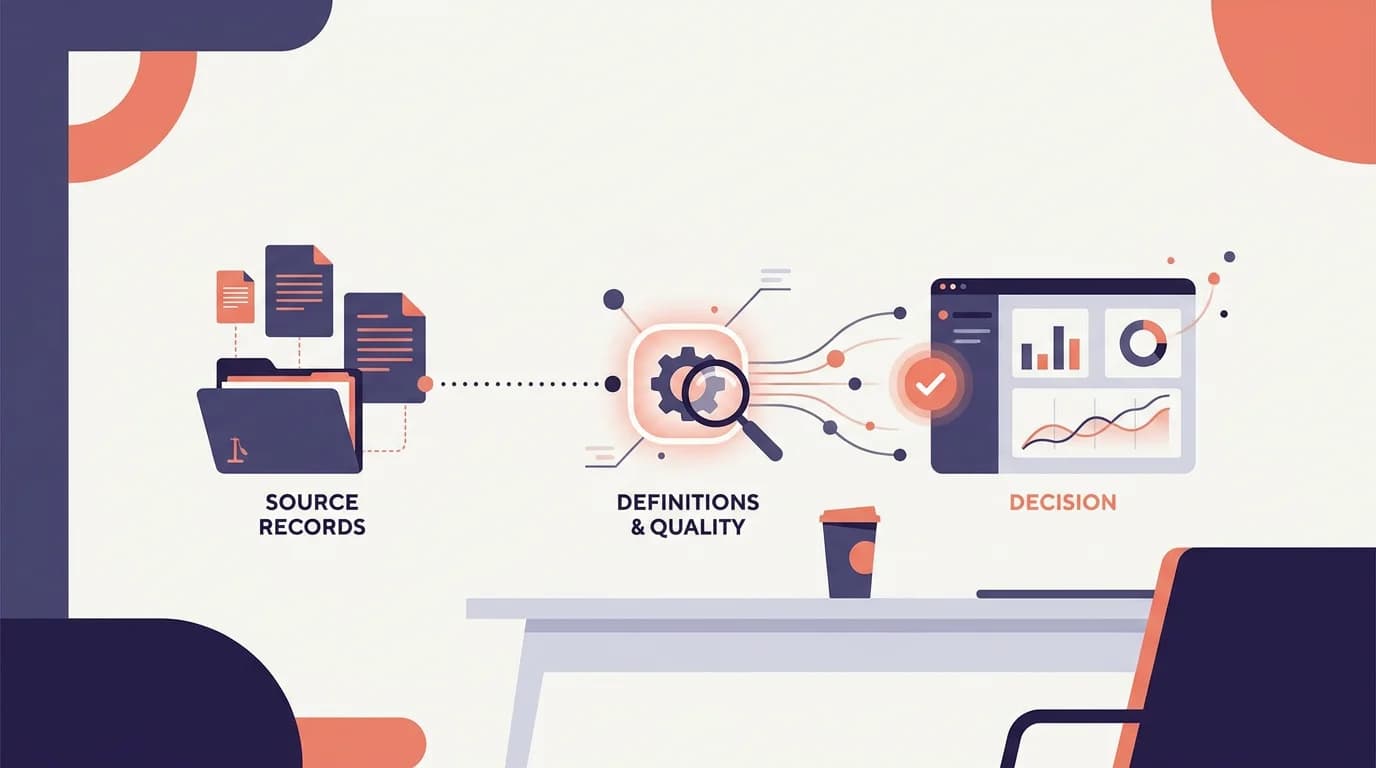
Read the role as a five-link evidence chain
The most useful way to decode a legal operations data role is to follow five links: business question, metric definition, source record, quality control, and decision. If a posting starts with dashboards but never identifies the decisions or underlying systems, the role may be mostly report production. If it asks you to define measures, reconcile sources, investigate anomalies, explain tradeoffs, and change an operating process, it carries broader analytical ownership. CLOC places Business Intelligence inside legal operations and defines it as collecting, organizing, analysing, and visualising data for decisions. The point is not the chart; it is the chain that makes the chart defensible.
Define the denominator before choosing the visual
Terms such as cycle time, backlog, matter volume, legal spend, adoption, and throughput can conceal several valid definitions. A contract cycle might start at request, assignment, first draft, or negotiation. A backlog might include every open request or only work that has passed triage. Before writing a query, pin down the unit, start and end events, status rules, exclusions, time window, owner, and refresh cadence. CLOC's metrics work treats a shared data dictionary and glossary as the foundation for consistent reporting across e-billing, matter-management, and contract systems. In an interview, a strong answer begins with the definition you aligned—not the dashboard tool you opened.
Source lineage separates analysis from number collection
Legal department data usually crosses systems. Intake records can hold request type and received date; CLM can hold contract stage and metadata; matter management can hold status and owner; e-billing can hold invoices, rates, accruals, and firm details; Finance systems can hold payments and budgets. F5's September 2026 role description joined legal-system reporting with CLM administration, data flows, integrations, permissions, and proactive data-quality work. Read postings for responsibility upstream of the report: mapping fields, documenting transformations, resolving duplicate identifiers, reconciling totals, and tracing a surprising number back to its record. Those verbs indicate that the analyst is expected to improve the evidence, not merely present it.
Corporate and law-firm data roles answer different questions
An in-house legal operations analyst may combine matter demand, contract flow, spend, vendor, resourcing, and technology-adoption data. A law-firm legal data role may sit closer to knowledge and innovation, using deal, matter, experience, pricing, or practice data. Goodwin's 2026 legal data analyst description focused on Tableau visualisations from deal and knowledge-management data, validation standards, practice-group requests, and data-literacy support. By contrast, Lazer Logistics' current senior legal operations analyst description combines Power BI reporting with matter status, outside-counsel spend, budgeting, forecasting, billing-data completeness, and leadership decisions. Employer context and source systems tell you more than the word data in the title.
Use the decision test to separate adjacent roles
Ask what happens after the analysis. If the work ends with invoice controls, budget variance, forecasting, and provider-spend recommendations, compare the legal spend analyst guide. If the centre is system configuration, workflow releases, UAT, and user support, the CLM administrator path may be closer. A general legal operations analyst role can include reporting alongside intake, systems, vendors, and process work. A data-focused role is strongest when it repeatedly owns definitions, source integrity, analysis, and the communication of a decision—not simply when SQL, Excel, Tableau, or Power BI appears in the skills list.
Build a small evidence packet, not a gallery of charts
Choose one operational question and preserve the reasoning. Show the metric definition, a simple source map, two or three quality tests, the analysis, the conclusion, and the decision or follow-up question. Explain one anomaly you investigated and one limitation you disclosed. Remove confidential matter, contract, employee, client, and vendor information; synthetic rows can demonstrate the method. Then browse legal operations jobs and search for combinations such as data quality, data dictionary, dashboard, metrics, source systems, reconciliation, Tableau, Power BI, SQL, matter management, CLM, and e-billing. Set a job alert for the work signals you want rather than relying on the exact title.